
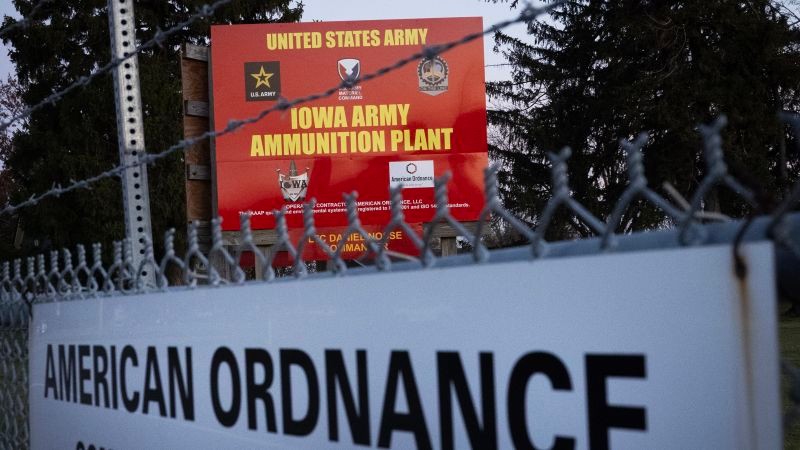
A federal judge on Monday ordered the U.S. Army to pause its plan to detonate five tons of lead azide at the Iowa Army Ammunition Plant near Middletown, after environmental activists sued over the potential health effects of the blast, CNN reported.
The order came just hours before the Army was set to carry out a two-part controlled explosion of 68 drums of the volatile compound, which officials say has degraded and become too dangerous to move. The detonation had already been pushed from Friday to Monday after pushback from residents and elected officials.
What the Army planned and why
The Army said it discovered the degrading lead azide in bunkers at the installation in March and has been working with the Environmental Protection Agency on a disposal plan since. Acting Army Secretary Adam Telle said the material is “extremely unstable and sensitive to even slight friction or movement,” making transport more dangerous than a controlled blast.
In a flyer sent to the community last month, the Army said packing and transporting the chemical “poses an unacceptable risk of accidental detonation to personnel handling and transporting as well as to the public.” Telle said Monday marked the “latest possible moment prior to a forecasted temperature drop, which would risk further destabilization of the material.”
The Army acknowledged the blast would send a plume of lead-containing particles into the air and could cause localized window damage. Residents in Middletown’s City Park neighborhood were asked to leave before the detonation, though the Army had not announced a time.
Residents and local officials push back
Critics said the Army moved too quickly and did not give the public enough information to prepare. Sen. Josh Turek said Thursday he had heard from many Iowans worried about lead exposure and called for a delay.
Lucy Giehl, who lives four miles north of the plant, told The Associated Press she wanted to know what would be done during the three-day postponement to help residents prepare. “There’s just so many details that I feel like haven’t been addressed with the public,” she said.
Daren Paul Morris, who walks his dog near the plant daily, told CNN affiliate KCRG he planned to evacuate but worried about what he would return to. “Hopefully I don’t have any broken windows. I just had the roof replaced,” he said. He added he would not mow his grass until after a good rain to avoid kicking up dust.
Health and environmental questions
Lead is toxic to the brain, and no level of exposure is considered safe. Patrick O’Shaughnessy, a University of Iowa professor and environmental health expert, told CNN that lead is heavier than air, so larger particles would likely land within 20 miles of the blast, while smaller particles could travel downwind toward Iowa City.
CNN meteorologist Chris Dolce said winds on Monday were forecast at only 5 to 10 mph, blowing from north to south. O’Shaughnessy said he and colleagues planned to monitor air and ground fallout.
The Army said its modeling predicted elevated lead levels in the air and that the plume would disperse and deposit particles on the ground. It has not said how much lead might be released.
Legal challenge and what happens next
The lawsuit, filed by environmental activists, argued the Army had not adequately assessed the risks of the detonation. The judge’s order pauses the plan while the case proceeds, according to CNN.
The Army had argued that waiting longer could make the material more unstable as temperatures drop. It is unclear when or whether the detonation will be rescheduled. The Army Ammunition Plant and the EPA did not immediately comment on the ruling.
For now, Middletown residents are left waiting, with the same questions about air quality, windows and dust that they had before the judge stepped in.
FAQ
What is lead azide and why is it dangerous?
Lead azide is a highly sensitive explosive used to detonate munitions. When dry, it can explode from shock, heat, flame or friction. The Army says the degraded material at the Iowa plant is too unstable to move safely.
Why did the Army want to detonate it now?
The Army said Monday was the last safe window before a forecasted temperature drop that could further destabilize the chemical, increasing the risk of an accidental explosion.
What did the judge’s order do?
The federal judge’s order pauses the detonation while a lawsuit filed by environmental activists moves forward. The Army has not said when it might reschedule.
How much lead could be released?
The Army has not quantified the release. Experts say lead particles are heavy and would mostly settle within 20 miles, but smaller particles could drift farther downwind.