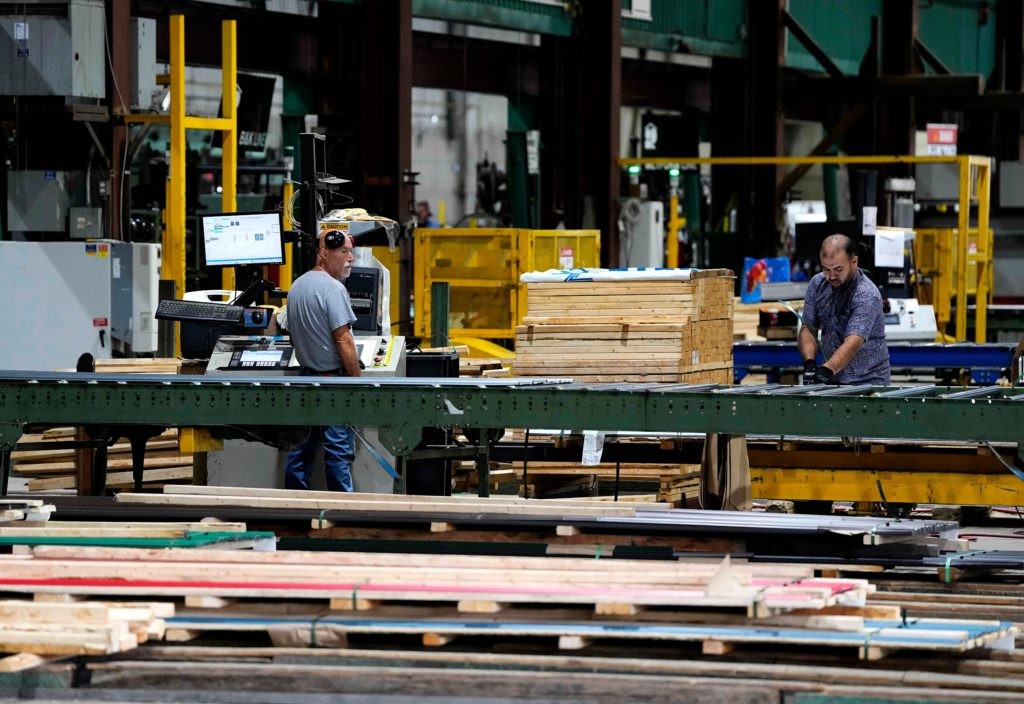
Factory layoffs tied to President Donald Trump's tariffs are stirring voter frustration across Iowa weeks before the Nov. 3 midterm election, and the state's closely watched U.S. Senate race is shaping up as a test of whether trade policy anger will cost Republicans votes.
According to reporting from PBS.org, drawing on Associated Press coverage, workers in battleground states including Iowa, Michigan, Kansas and Ohio are confronting plant closures, farm foreclosures and higher prices, and some longtime Republican voters say the tariff strategy has let them down.
Burlington Family Loses Four Jobs in Weeks
Tracy Chew, 55, of Burlington, Iowa, worked for Case, a backhoe manufacturer. The company announced before the tariffs took effect that it would close its Burlington plant, and Chew lost her job in April. Her daughter was laid off next, followed by her husband and son-in-law within weeks.
Chew voted for Trump in 2016, then for Democrat Joe Biden in 2020 and Democrat Kamala Harris in 2024. She told the AP she is leaning toward Democrats again this year and feels Trump has not done enough.
“I'm furious he isn't doing enough,” Chew said. “Tariffs are not targeting the right companies, the right amount.”
Winnebago Cuts 200 Iowa Jobs as Import Costs Climb
The pain has not been limited to Burlington. Winnebago Industries, the Iowa-based recreational vehicle maker, cut 200 jobs last year after the cost of importing aluminum, steel and electronics rose by tens of millions of dollars.
“It's a day to day battle,” said Michael Happe, the company's chief executive.
Those layoffs land as U.S. Rep. Ashley Hinson, a Republican, faces Democratic state Rep. Josh Turek in a tight race for Iowa's open U.S. Senate seat. Hinson has already drawn attention this cycle on trade and energy questions, as covered previously by Just The News Iowa.
What the White House Says About the Tariff Strategy
Trump promised that charging higher taxes on imports would trigger a factory renaissance in the United States. That has not materialized so far. The country has added manufacturing jobs this year, but the sector employs fewer people than it did when Trump returned to the White House in January 2025, according to the AP's reporting.
White House spokeswoman Taylor Rogers insisted a factory boom is underway, pointing to gains in manufacturing output and certain nonresidential construction trades.
“Factory construction jobs of today mean more manufacturing jobs down the road once those factories come online,” Rogers said.
Public opinion has moved against the president's trade approach. A September poll by The Associated Press-NORC Center for Public Affairs Research found only about 3 in 10 U.S. adults approve of Trump's handling of trade negotiations, down from 4 in 10 in March. The AP's full report is available here.
Legal and Economic Turbulence Around Trade Policy
The Supreme Court in February ruled against Trump's declaration of an emergency to roll out his “Liberation Day” tariffs last year, leaving trade policy unsettled as the administration continues adjusting with new levies and threats. In one high-stakes case, Trump has threatened to ban sales of Canadian jet maker Bombardier in the U.S. unless it builds all its planes here. The company says it buys parts from 2,800 companies across 47 states.
Most economists argue broad universal tariffs cause more pain than help, though tariffs are far from the only reason manufacturing jobs have disappeared. Factories have been cutting workers for decades regardless of trade policy.
Ernie Goss, an economist at Creighton University in Nebraska, said manufacturing woes may not translate into Democratic victories. Some voters, he said, may “think the tariffs in the long run will work.”
Will Iowa Workers Switch Parties?
Not every frustrated worker is ready to abandon the GOP. Koby Bird, who retired from a South Carolina bicycle factory that closed last year, said he supports tariffs but criticized Trump's unpredictable application of them.
“It was all over the place,” Bird said. “Businesses couldn't plan.”
Even so, Bird plans to stick with Republicans next month, reasoning that Democrats would spend too much money on the wrong things.
In Pennsylvania, union leader Wendell Young said he senses a real shift among rank-and-file workers after 160 jobs were cut at a Post Holdings pet food plant.
“People used to beat me up for not supporting Trump. I haven't heard that in a year,” said Young, president of Local 1776 of the United Food and Commercial Workers International Union. “Some of these people are red Republicans and they are shocked. They expected more jobs.”
For Iowa Republicans, the question heading into November is whether voters like Chew, angry over lost factory paychecks, outweigh those willing to wait out the trade strategy. National Democrats have avoided making Harris the face of their midterm effort, as Just The News Iowa reported, leaving local economic frustration to carry the argument in races such as Hinson versus Turek.
Frequently Asked Questions
How many jobs has Winnebago cut in Iowa because of tariffs?
Winnebago Industries cut 200 jobs last year after the cost of importing aluminum, steel and electronics rose by tens of millions of dollars, according to the company.
Which Iowa races could be affected by tariff backlash?
The open U.S. Senate race between Republican Rep. Ashley Hinson and Democratic state Rep. Josh Turek is considered close, and economic frustration over factory layoffs could influence the outcome.
Do most Americans approve of Trump's handling of trade?
No. An AP-NORC poll in September found only about 3 in 10 U.S. adults approve of Trump's trade negotiations, down from 4 in 10 in March.