
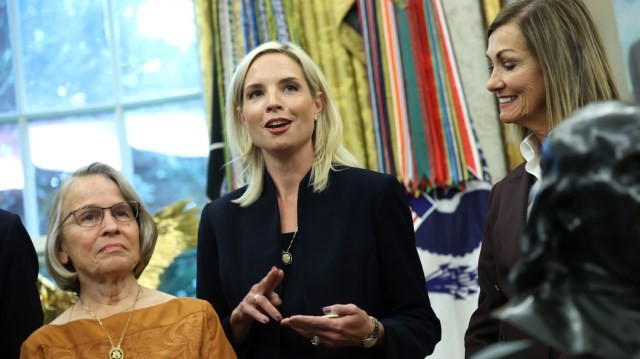
Iowa Republican Senate candidate Ashley Hinson said Tuesday she opposes President Trump's deal to import 300,000 tons of diesel from Russia, arguing the United States should lower fuel prices at home rather than bargain with an adversary.
Speaking during the second televised Iowa Senate debate hosted by WHO 13 on October 14, Hinson split with the president on one of the highest-profile issues of the campaign season: diesel prices that have climbed toward $6 a gallon in Iowa and are squeezing farmers and truckers across the state.
Hinson: Lower Prices, But Not With Putin's Help
According to The Hill, Hinson said the country needs cheaper fuel, but not through a deal with Moscow.
“We need to lower gas prices in this country. We need to lower diesel prices, but I don't think we need to be making a deal with Russia to do it,” Hinson said during the debate, which was hosted by WHO 13, a Nexstar affiliate.
“I think we should be doing it by lowering the gas tax temporarily, making sure we're actually looking at potentially a diesel rebate program for our producers, investing in America's biofuels, which is the homegrown answer that we have right here in Iowa,” she added.
Her answer puts Iowa's homegrown energy industry at the center of the fuel price fight. Biofuels have long been a pillar of the state's farm economy, and Hinson's push to expand them positions Iowa producers as the alternative to foreign diesel. It is a message tailored to a state where ethanol and biodiesel plants anchor rural communities.
Earlier Tuesday, Hinson told The Associated Press she had deeper concerns about the arrangement.
“It makes me a little bit nervous anytime we're talking about relieving a sanction on Russia,” Hinson said.
That quote was also highlighted by Fortune in its reporting on the bipartisan backlash to the deal in Congress.
What the Russia Diesel Deal Would Do
President Trump announced the deal last week, saying Russia had agreed to send 300,000 tons of diesel to the U.S. and the global marketplace. The move is aimed at driving down pump prices weeks before the election.
The announcement drew criticism from both parties. Six Republican senators signed a letter released Tuesday criticizing the president for striking the deal with Russia, according to The Hill.
As Axios reported, Senator Chuck Grassley of Iowa was among lawmakers who had urged Trump to ban diesel exports, a step the president initially embraced before the White House abruptly reversed course and ruled out a ban.
Turek Agrees, Putting Fuel Prices Front and Center
Democrat Josh Turek, Hinson's opponent, said during the debate that the two candidates actually agree on this issue. He said he does not support the diesel deal with Russia either.
“We actually agree on this. I want to do everything that I can because everywhere I'm going, all across Iowa, I'm hearing from Iowans talking about gas prices and diesel prices,” Turek said.
“But I don't think it should be at the expense of benefiting the economy of someone like a Vladimir Putin, who we clearly cannot trust,” he added.
The rare moment of agreement underscores how much fuel costs are weighing on Iowa voters this fall. Diesel running near $6 a gallon, as Fortune reported, has become a defining issue in the race. For a state that moves grain, livestock, and goods by truck and tractor, diesel prices hit the bottom line of nearly every farm and small business.
The debate also covered other contentious ground, as reported earlier by Just The News Iowa.
Iowa's Stake in the Energy Fight
Hinson's break with the president is notable in a battleground race, but it follows a pattern. Last month she said Iowans “shouldn't have to foot the bill at the pump or the checkout line for the war in Iran,” an acknowledgment that foreign conflicts are driving up costs for American families.
Her preferred solutions, a temporary gas tax cut, a diesel rebate for producers, and investment in biofuels, would keep energy dollars inside the United States rather than sending them to Moscow. That argument resonates with Iowa producers who have spent years building a domestic renewable fuels industry and want Washington to back it.
Senator Grassley's push for an export ban, reported by Axios, reflects the same instinct among Iowa Republicans: produce more fuel at home and stop depending on foreign suppliers, friendly or not.
The diesel question has also created awkward moments for Republican candidates elsewhere. South Carolina Senator Darline Graham declined to say during a weekend debate whether she agreed with the president's deal.
“I think that everybody wants the war in Ukraine to end. We will all be safer when the war in Ukraine ends,” Graham said.
Graham said she was proud of legislation she helped pass that enacted sanctions on Russian energy buyers, and she framed the deal as a tool the president can use to end the war and bring down prices.
Frequently Asked Questions
What is Trump's Russia diesel deal?
It is an agreement announced the week of October 6, 2026, under which Russia would send 300,000 tons of diesel to the U.S. and global markets in an effort to lower fuel prices before the election.
Why does Ashley Hinson oppose the deal?
Hinson said the U.S. should lower diesel and gas prices through domestic measures such as a temporary gas tax cut, a diesel rebate for producers, and investment in biofuels, rather than through a deal with Russia.
Does Josh Turek support the Russia diesel deal?
No. Turek said during the October 14 debate that he opposes the deal because it would benefit the economy of Vladimir Putin, whom he said the U.S. cannot trust.
How high are diesel prices in Iowa?
Diesel prices have reached about $6 a gallon in Iowa, according to Fortune, and both Senate candidates say voters raise fuel costs at campaign stops across the state.