
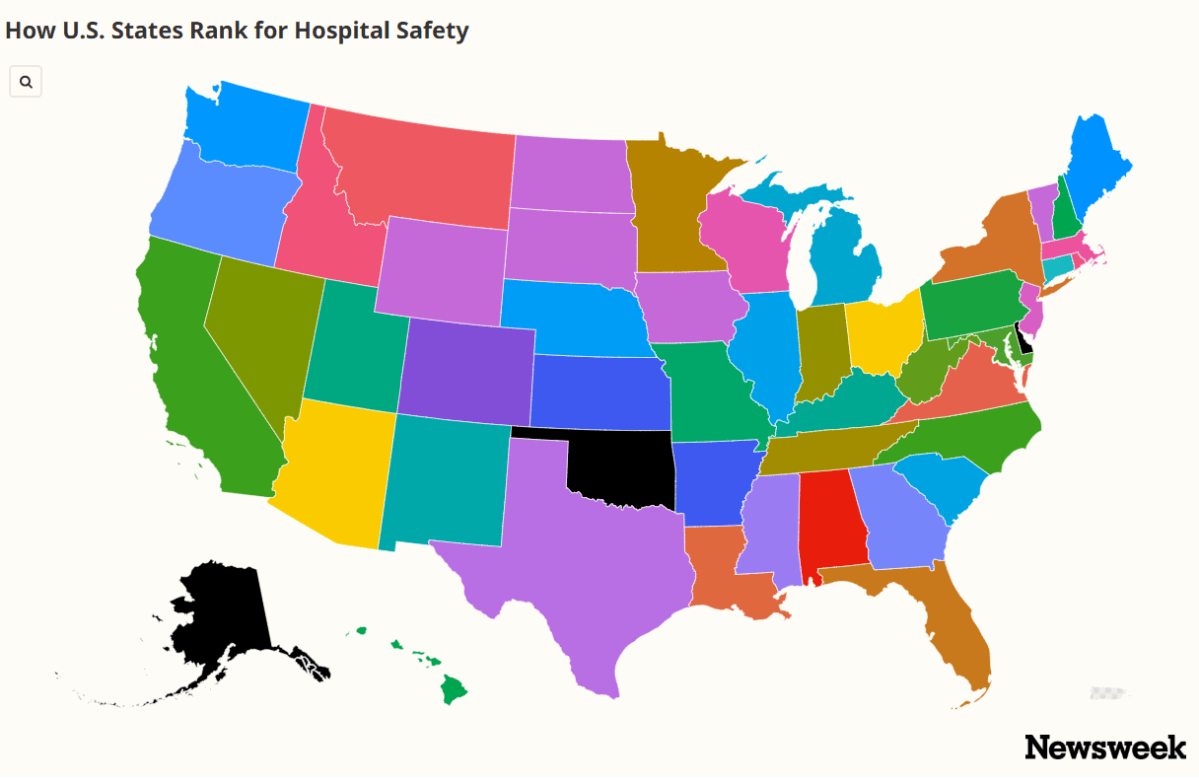
Iowa landed at the very bottom of a new national ranking of hospital patient safety, with none of its graded hospitals earning an A in the fall 2026 Hospital Safety Grades released November 18 by The Leapfrog Group.
Iowa shares last place with North Dakota, South Dakota, Vermont and Wyoming, each at 0 percent A-rated hospitals. The Hawkeye State actually slipped backward from the spring 2026 cycle, when 3.3 percent of its graded hospitals earned an A, according to Newsweek's report on the rankings.
What the fall 2026 grades show
The Leapfrog Group, an independent national nonprofit focused on patient safety and transparency, assigns letter grades from A to F to eligible general hospitals based on up to 22 evidence-based measures covering medical errors, infections, accidents and injuries. The data draws on sources including Centers for Medicare & Medicaid Services figures and the Leapfrog Hospital Survey.
Nationwide, 900 hospitals earned an A this cycle, 774 received a B, 655 got a C and 35 a D, while three hospitals received an F. In total, 2,366 hospitals were assigned grades.
At the top of the state table, Connecticut retained first place with 64.3 percent of its graded hospitals earning an A, followed by Utah at 55.2 percent, New Jersey at 53.7 percent, South Carolina at 52.9 percent and Virginia at 52.1 percent, according to Leapfrog's announcement.
Just above the bottom five, New Mexico ranked 46th with 5.3 percent of its hospitals earning an A, down from 10.5 percent in the spring. Alabama followed at 13 percent and Missouri at 13.3 percent. Nebraska, Iowa's western neighbor, ranked 43rd with 15 percent, RamaOnHealthcare reported.
What the bottom ranking means for Iowans
The state table measures only the percentage of A-rated hospitals in each state, so a last-place ranking does not mean every Iowa hospital is unsafe. A low-ranking state can still contain hospitals with strong safety scores, and a highly ranked state can contain facilities with lower grades. Leapfrog itself cautions that its grades should not be the sole basis for evaluating a hospital or making treatment decisions.
Some states moved sharply between grading cycles, which shows how quickly the picture can change. West Virginia jumped from 46th in the spring to 32nd this fall as its share of A hospitals rose from 8.7 percent to 22.7 percent. Montana fell the other way, dropping from fifth to 35th as its A share fell from 44.4 percent to 22.2 percent.
The grades also do not cover every hospital in the country. Some facilities cannot be graded because sufficient CMS data are unavailable, including certain critical access hospitals, rural emergency hospitals, VA hospitals and Indian Health Service facilities, a limitation that matters in a rural state like Iowa. For the fall cycle, Leapfrog also declined to grade hospitals that did not participate in its 2025 or 2026 Hospital Survey, following litigation involving Florida hospitals.
Price transparency and the safety question
The new grades arrive as the Trump administration and Congress push to expand health care price transparency. Leapfrog argues that giving consumers cost information without comparable safety information provides only part of the picture, a message with clear relevance for Iowa families and employers shopping for care.
Research cited by Leapfrog from the Purchaser Business Group on Health found little to no relationship between negotiated hospital prices and quality. In Seattle, an A-rated hospital had negotiated inpatient rates between 195 percent and 239 percent of a national Medicare benchmark, while a C-rated hospital in the same market charged between 350 percent and 467 percent of that benchmark.
Elizabeth Mitchell, president and CEO of the Purchaser Business Group on Health, said the findings show employers cannot rely on price as a proxy for quality.
When we put the data together, some of the most expensive hospitals were not the safest, she said. Our members want to buy high-quality, safe care that is fairly priced.
Leah Binder, president and CEO of The Leapfrog Group, praised hospitals that report their performance publicly.
A record number of hospitals are choosing to publicly report their safety and quality performance, and we applaud them for holding themselves accountable to their patients, Binder said in announcing the results. Progress on price transparency is important, but there's no good price for bad care.
How to check your hospital's grade
Iowans can look up individual facilities through HospitalSafetyGrade.org, which now displays the fall 2026 results. The site shows a hospital's overall grade plus detailed results on infections, surgical problems, safety practices and measures involving doctors, nurses and hospital staff. Leapfrog releases its grades twice a year and retained the same numerical cutoffs this fall as in the spring, so patients can track individual hospital performance over time.
For fall 2026, an A required a numerical score of at least 3.202, while hospitals scoring below 1.837 received an F, according to Chief Healthcare Executive's coverage of the methodology.
Frequently asked questions
Did any Iowa hospital receive an A for patient safety?
No. In the fall 2026 Leapfrog grades, none of Iowa's graded hospitals received an A, down from 3.3 percent in the spring 2026 cycle.
Does a bottom ranking mean Iowa hospitals are unsafe?
Not necessarily. The state ranking measures only the share of A-rated hospitals, and individual Iowa hospitals may still hold B or C grades that reflect acceptable safety performance.
How often does Leapfrog update its hospital safety grades?
The Leapfrog Group releases its Hospital Safety Grades twice a year, in spring and fall cycles.