
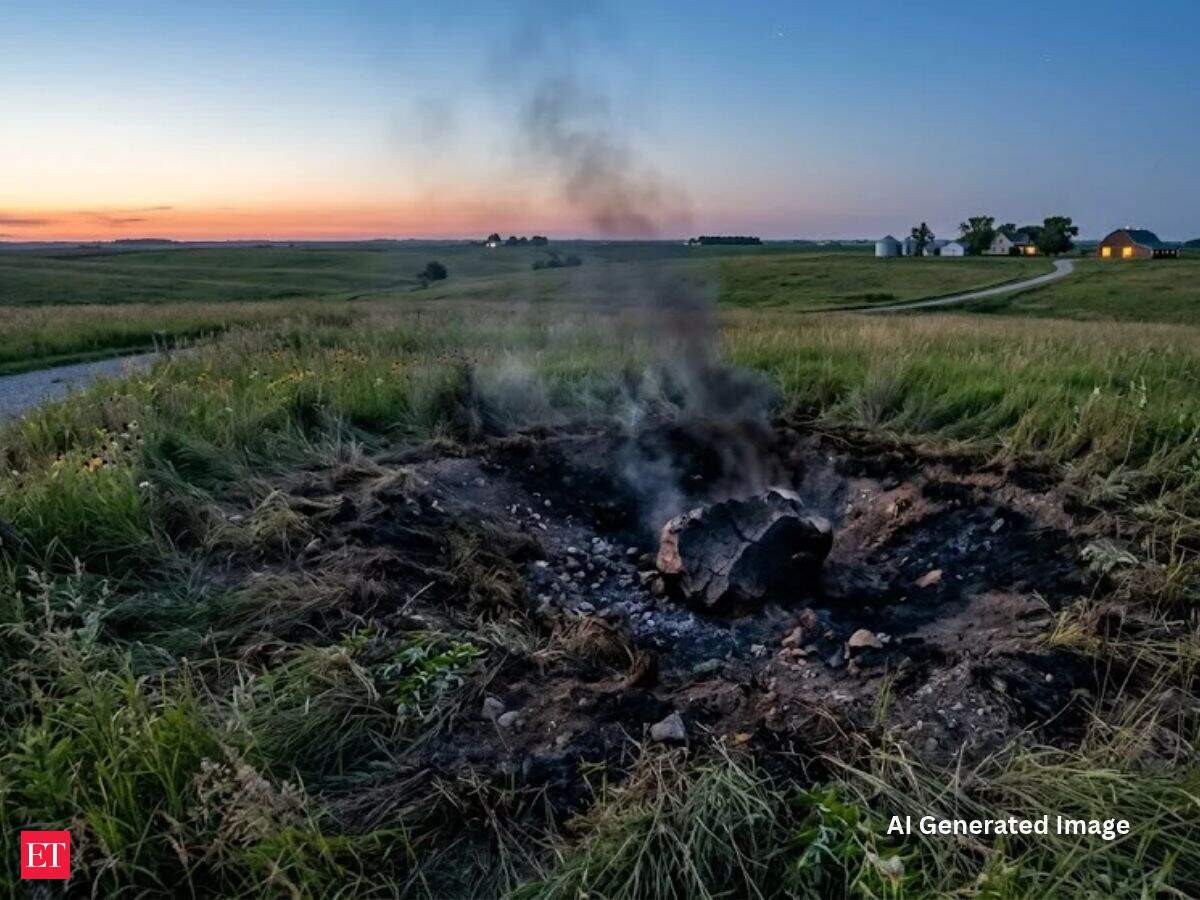
On the evening of May 2, 1890, a meteorite slammed into an Iowa prairie and buried itself about three feet underground, setting off a legal fight that reached the Iowa Supreme Court and settled a property rights question Iowans still live with today. A neighbor dug the 66 pound stone off another man's land, sold it for $105, and learned the hard way that finding something is not the same as owning it.
The story, reported by Economic Times, began when the fireball streaked across the sky from Des Moines to Mason City. The meteor exploded about eleven miles northwest of Forest City and scattered fragments over a strip three or four miles long, according to a 1929 newspaper account drawing on the State Historical Society of Iowa's journal The Palimpsest. Roughly 122 kilograms of material was eventually recovered, Meteorite Times reported in 2022. The crown jewel was a single stone of about 66 pounds on a Winnebago County farm.
The farmer, the geologist, and a $105 handshake
The man who dug it out was a farmer named Peter Hoagland. The land itself had belonged to John Goddard since about 1857, and the 1890 grass was leased to another man, James Eleckson, according to the Iowa Supreme Court's opinion reproduced in the Annals of Iowa. Hoagland was a neighbor with no ownership stake at all.
Word of the fall traveled fast. Horace V. Winchell, a geologist who raced down from Minnesota on behalf of the University of Minnesota's museum, spelled the farmer's name differently in a first person account he wrote for The Atlantic Monthly in 1923, but his recollection of the bargaining is vivid. Hoagland's wife told him the couple had been embarrassed that they could not contribute to a new church, and they saw the stone as a gift from above. The farmer opened negotiations at $300.
Winchell offered $75. Then a second buyer's carriage appeared across the field, and the bids inched upward. Winchell's final offer of $105 won the day. The rival walked away, and Winchell packed the stone in a strong box and shipped it to Minneapolis by express.
The sheriff steps in
Before dawn the next morning, a sheriff stopped Winchell on the road to the railway station and seized the box on a writ of replevin, a court order used to recover disputed property. Goddard, the landowner, had gone to court to claim what had fallen on his ground. The district court sided with him, and Hoagland had to surrender his $105, according to the 1929 account.
Winchell then did something his own lawyer thought could not be done. While the first case was still on appeal, he persuaded the University of Minnesota to file a second action to recover the meteorite. Attorney Charles B. Elliott posted a $400 bond, double Goddard's, and traveled to Forest City, where the stone sat in a gunny sack in a bank vault.
What happened next comes from Minnesota side retellings, so the details deserve some caution. Winchell wrote that a scuffle broke out in the bank, that Elliott escaped in a hired carriage, and that he finally heaved the stone onto an empty flat car and rode a freight train to Albert Lea. A 2008 University of Minnesota alumni magazine article by Tim Brady, drawing on Elliott's own memoir, tells the story with similar beats. Winchell added that he then buried the stone in a vacant shed near campus, where it hid for about a year.
What the Iowa Supreme Court decided
In October 1892, the Iowa Supreme Court upheld the lower court's ruling. The principle it announced was plain: a meteorite embedded in someone's land belongs to the landowner, not whoever happens to dig it out. As the case summary put it, just because you dig it out and take it away does not mean you have the right to claim it when you find it.
The ruling, known as Goddard v. Winchell, still stands as a landmark in property law. Courts across the country have cited it when sorting out who owns objects found in or on private ground. For Iowa landowners, the logic tracks with a principle conservatives have long defended: your property is yours, and what lands on it does not become community property just because a stranger got to it first.
The legal fight did not end with the Supreme Court. The university was later sued on the bond connected to its dramatic recovery of the stone. A jury valued the meteorite at $480, more than four times what Winchell had paid for it. Only after that bill was settled did the stone finally go on display at the University of Minnesota's museum.
Why a 134 year old case still matters
Goddard v. Winchell established a rule that protects landowners to this day: a meteorite that becomes embedded in privately owned land can belong to the landowner rather than the finder. The dispute drew a bright line between discovering an object and having the legal right to sell it.
The case is also a clean example of something art and antiquities markets still wrestle with. A price is not the same as a title. Winchell paid $105 in good faith and still lost the stone, because the man who sold it had no right to sell it, as Inkl recounts in its writeup of the affair.
By Winchell's account, Hoagland wanted that money for his church. He ended up handing every dollar back, while the stone went to a museum in Minneapolis and a jury set its price at $480. Winchell called it his first lawsuit and drew a practical lesson from the ordeal:
Among your instruments be sure to keep a replevin in good working order.
For Iowans who find something strange in a field, the lesson from Forest City is simpler: check who owns the land before you start digging.
Frequently asked questions
Who owns a meteorite found on private land in Iowa?
Under the precedent set in Goddard v. Winchell in 1892, a meteorite embedded in privately owned land belongs to the landowner, not the person who finds or digs it up.
How much did the 1890 Iowa meteorite sell for?
Farmer Peter Hoagland sold the 66 pound stone to geologist Horace V. Winchell for $105 on May 5, 1890. A jury later valued the meteorite at $480 during the ensuing litigation.
Where is the Forest City meteorite today?
After the legal disputes ended and the $480 judgment was paid, the meteorite went to the University of Minnesota's museum in Minneapolis, where it has remained.