
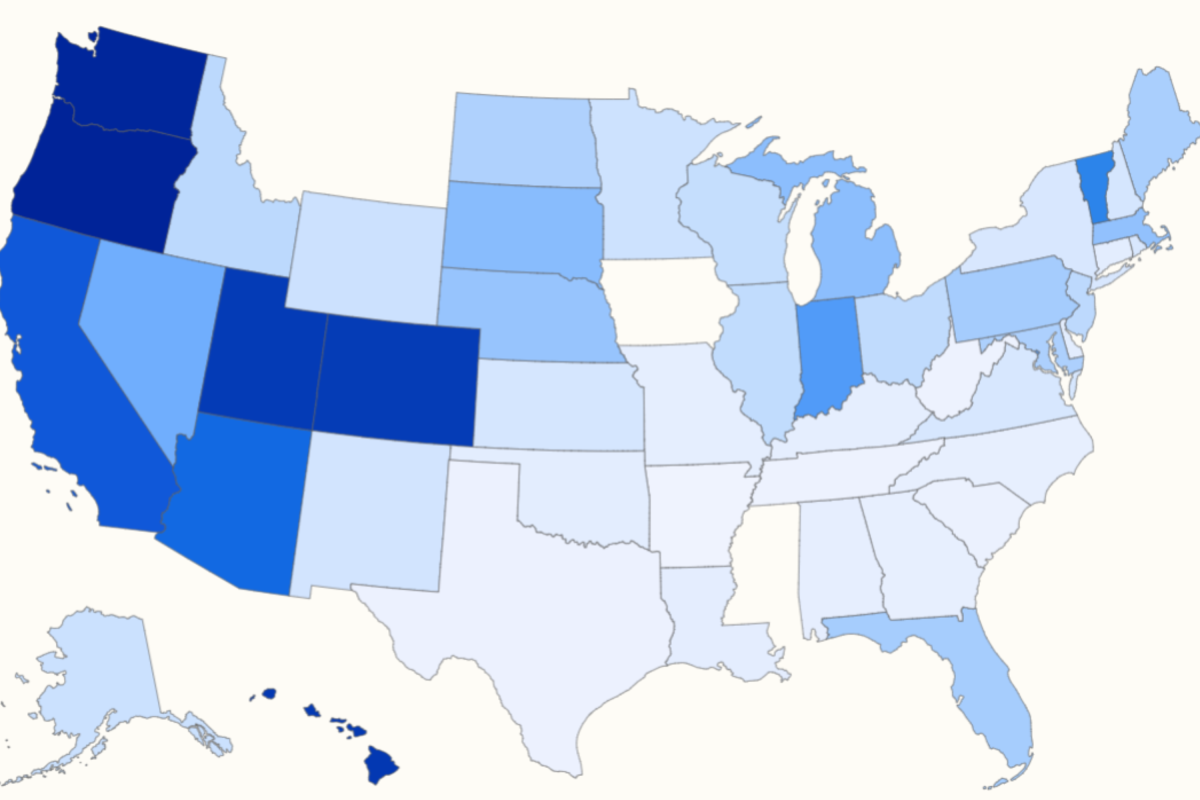
States where most voters cast their ballots by mail could face the greatest disruption if the Trump administration is allowed to impose new postal requirements before November's midterm elections, a Newsweek analysis of federal election data shows. The rules, which would require election officials to use a federal portal and approved ballot envelopes, remain blocked by litigation but the administration is asking the Supreme Court to let them take effect before the November 3 vote.
Which states rely most on mail voting?
Oregon and Washington relied on mailed ballots for more than 98 percent of turnout in the 2024 general election, according to data from the Election Assistance Commission (EAC). Hawaii, Utah and Colorado exceeded 90 percent, while California and Arizona also recorded mail-voting majorities.
Oregon had the country's highest mail-turnout share in 2024 at 99.3 percent, followed by Washington at 98.5 percent. Hawaii stood at 92.5 percent, Utah at 91.5 percent and Colorado at 91.3 percent. California recorded an 80.8 percent share and counted 13,062,318 mail ballots.
Arizona was next among the highest-use states at 74.7 percent, representing more than 2.8 million counted mail ballots. Vermont followed at 64.7 percent, while Indiana recorded 53.7 percent and the District of Columbia 51.1 percent.
What are the new postal rules?
The U.S. Postal Service (USPS) adopted a final rule requiring state and local election officials to provide specified voter information and use approved ballot-mail materials for federal elections. The administration says the measures would help enforce federal law and reduce the risk of fraud, while opponents argue the federal government lacks the authority to impose the requirements and that late implementation could disrupt established election systems.
The rule remains blocked while litigation continues. Justice Ketanji Brown Jackson asked the challengers to respond to the administration's application by September 8.
What does the USPS say?
USPS pointed Newsweek to a September 1 statement saying it was finalizing the Federal Ballot Mail Portal and would soon let election officials familiarize themselves with the platform voluntarily. The agency said its work had remained consistent with court orders and that, under the temporary restraining order, verification procedures prior to acceptance are not being performed.
USPS said it was committed to transparency, accountability, and working constructively with election officials, Congress, the courts and other stakeholders.
How widespread is mail voting nationally?
Nationally, mail voting accounted for 30.3 percent of turnout in 2024. States reported transmitting 66,867,671 mail ballots, receiving 47,957,093 and counting 47,629,437. The EAC calculated a 98.8 percent count rate among returned ballots.
Mail use remained below the extraordinary level recorded during the coronavirus pandemic. The number cast and counted rose from 33,140,081 in 2016 to 69,337,349 in 2020 before falling to 46,846,449 in 2024.
Reliance on mail voting also extends beyond postal delivery. Thirty-six states reported using ballot drop boxes, and almost 15 million ballots were returned through them. Forty-three states allowed voters to correct, or cure, certain errors on mail ballots.
What the data does not show
The data measure voting behavior in the 2024 general election. They are not a forecast of 2026 turnout, a count of voters who would be disenfranchised or an estimate of which party could benefit. State figures also carry reporting limitations.
The EAC marks unavailable data with dashes and warns that mail ballots transmitted, returned, counted and recorded as mail voters may not match because states use different reporting methods. Iowa, Mississippi and Montana were marked as unavailable because the EAC did not report comparable percentages for those states.
Still, the central geographic pattern is clear. A postal requirement affecting ballot preparation or processing would intersect with almost every vote cast in Oregon and Washington, but with only a small minority in several Southern states.