
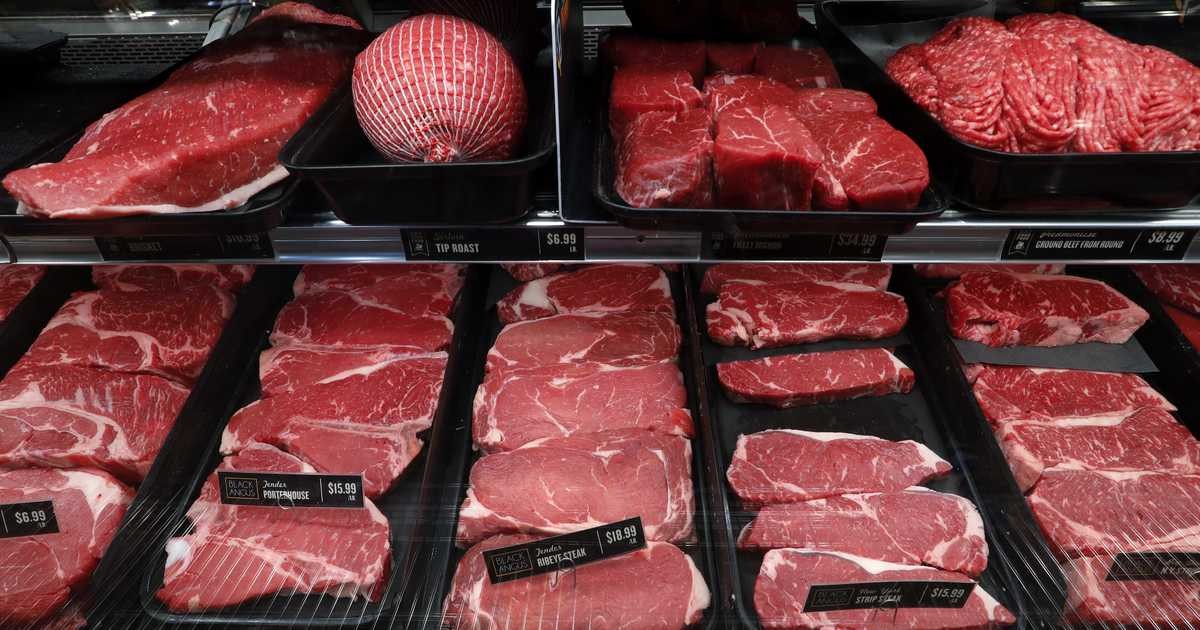
President Donald Trump announced Friday he is directing legal action to break up what he calls the “nasty monopoly” of the four major meat processors, a move that could give Iowa farmers and ranchers the right to process their own livestock. The announcement, made on Truth Social, targets a sector long criticized for squeezing producers and keeping grocery prices high.
“Ranchers and Farmers have always been a number one priority for me,” Trump wrote. “They work very hard, are smart, efficient, and immaculately CLEAN, but for years I have heard that they have had a tremendous problem with the Big Processors, who many say are a nasty Monopoly. There are, essentially, 4 of them, a very non competitive number, and they make life miserable for our wonderful Farmers and Ranchers, and I can't let that happen, can I?”
Trump said he is “authorizing legal documents to be drawn in order to allow Farmers and Ranchers to be given the right to PROCESS THEIR OWN FOOD,” adding that the effort “should move quickly.”
What does “process their own food” mean?
The president’s statement leaves key questions open. Does it mean farmers can process their own livestock for personal use, or does it extend to selling directly to consumers? The latter would be a significant shift, decentralizing an industry dominated by four foreign-owned conglomerates and giving producers a larger share of the profit.
For Iowa, this could revive a tradition that still thrives in parts of the state: the local meat locker. Family-owned lockers in eastern Iowa and beyond have long served their communities, processing local stock and selling quality pork and beef that rivals anything in a big-box grocery store. Expanding that model could reshape how Iowans buy meat.
Why the big four matter to Iowa farmers
Four companies control roughly 80% of U.S. beef processing, and much of that ownership is based overseas. For years, farmers and ranchers have complained that these processors dictate prices, leaving producers with thin margins while consumers pay premium prices at the register.
Allowing on-farm or local processing would break that grip, at least in part. Costs could be marginally higher without the economies of scale, but for many Iowans, the trade-off is worth it for fresher, higher-quality meat and a fairer deal for producers.
Beef herd at historic low, but signs of recovery
One challenge remains: the American beef cattle herd is at its lowest level since 1961. Drought and high feed costs have forced ranchers to cull herds, and rebuilding takes years. There are hopeful signs, including an increase in heifers retained for replacement, but supply and demand will keep pressure on prices in the near term.
Still, the president’s move signals a broader push for competition and local control, themes that resonate strongly in Iowa’s agricultural communities.
What happens next
The exact text of the president’s action has not been released. Farmers, ranchers, and consumers will be watching closely to see whether this becomes a practical tool for local processing or a symbolic gesture. Either way, the conversation about breaking up the meat monopoly is now front and center.
For Iowa, the stakes are personal. From the family farm to the local locker, this is about who controls the food system and who benefits from it.