
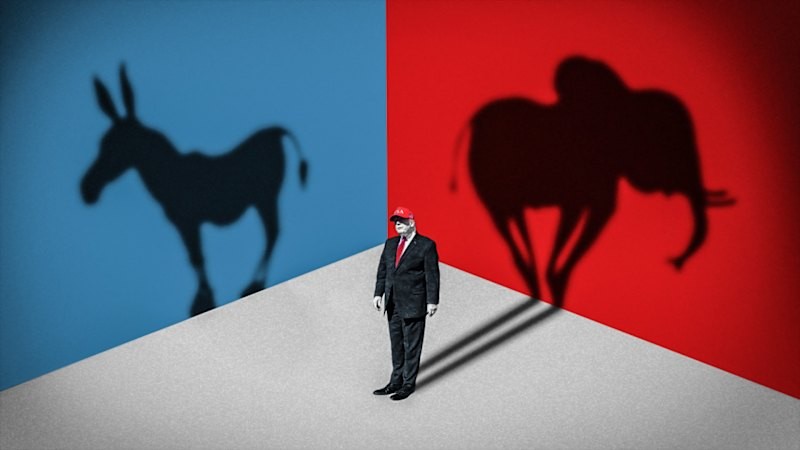
President Donald Trump has visited Ohio twice in nine days, according to reporting from The Sydney Morning Herald, as Republicans work to hold Senate seats in states they usually win, including Iowa, with control of the chamber up for grabs in the November midterms.
The Cook Political Report rates several GOP-held Senate seats as toss-ups this cycle, including the Ohio seat held by Jon Husted, who replaced JD Vance when Trump tapped him for vice president. Iowa, Alaska, Kansas, Maine and even Texas, which has not sent a Democrat to the Senate since 1988, are also on the list. Democrats need a net gain of four seats to take the majority.
Why Ohio Matters for Republican Senate Hopes
Husted faces Democrat Sherrod Brown, who held an Ohio Senate seat from 2007 to 2025. More than $400 million has already been spent on that race alone, making it one of the most expensive Senate contests in the country, The Sydney Morning Herald reported. Democratic strategist Morgan Jackson told the paper the Ohio race could be the closest of all Senate contests this year.
Trump won Ohio three times, each time by a larger margin, including an 11-point victory over Kamala Harris in 2024. But the president's approval ratings are at record lows, and Democrats are eager to make the midterms a referendum on him. Trump is leaving Washington almost daily for rallies where he urges conservatives to pretend he is on the ballot and show up to vote.
MS NOW reported that Trump's second Ohio trip in two weeks, campaigning for the GOP's picks for governor and Senate, underscores how Republicans are playing defense in the final stretch. His tour has also stopped in red states including Texas, Alabama, Montana, Oklahoma and Alaska, with upcoming visits to Georgia, Kentucky and Kansas.
Voters in Trump Country Are Split on Prices and Foreign Policy
Reporting from Wapakoneta, a small town in heavily Republican Auglaize County, where Trump won more than 80 percent of the vote in 2024, found some past supporters wavering. Arthur Eversman, a 31-year-old factory worker who voted for Trump in the past, told The Sydney Morning Herald he plans to sit out this election, citing what he called a 'magical war with Iran' and its effect on fuel prices.
'The cost of everything has gone up,' Eversman said. 'The relief on everything is non-existent. We're just continuing these proxy wars and paying for them, yet the ramifications are on us directly.'
Others remain firmly behind the president. Ted Zwiebel, a 31-year-old worker at the Pratt Paper Mill in Wapakoneta, a plant opened by Trump in 2019, said his admiration is undimmed.
'He doesn't do everything I like, but he gets the majority of it right,' Zwiebel said. 'I think he's doing exactly what he said he was gonna do. Nothing is going to be easy when you've got to start from the bottom.'
Still, Zwiebel acknowledged that diehard Trump supporters in his own family are having doubts, mainly over groceries and fuel costs. He said it costs him $120 a week in gas to drive 11 miles to work in a truck that gets 11 miles per gallon.
Rural Voters and the Farm Economy
Some rural voters are voicing frustration with the administration's trade and energy policies. Christopher Gibbs, a cattle, corn and soybean farmer on 560 acres in Maplewood and a former local Republican Party chairman who now chairs the Shelby County Democrats, said his combine costs nearly $1,000 to fill with diesel, close to double what it used to be.
'He promised the golden age of agriculture. We're still in a cashflow and working capital crisis. We're in our third year of that, losing money,' Gibbs said.
His complaint about the farm economy will sound familiar to Iowa readers, where agricultural interests have watched tariff fights with China and Canada squeeze margins. Greg Lawson, a senior research fellow at the Buckeye Institute, a conservative Ohio think tank, told The Sydney Morning Herald that the cumulative effect of inflation, high fuel prices and property tax spikes is hurting people even if some costs have eased from their peaks.
Ohio's outgoing Republican governor, Mike DeWine, suspended the state's motor fuel tax for 90 days this month, a sign of how pressing the cost of fuel has become for Midwest voters.
Data Centres Divide the Republican Coalition
One issue where the White House message clashes with local Republicans is the spread of AI data centres. Trump has said communities that reject data centres will end up 'backwards and poor.' Vivek Ramaswamy, the Republican candidate for Ohio governor, is promising a more measured approach that would require developers to show a facility benefits the community.
Some voters have flipped over the issue. Brandyn Bernard, a 37-year-old from Pataskala who voted for Trump three times and flew a MAGA flag outside his home, is now campaigning for Democrats because of his opposition to data centres.
'I would rather be broke and the town be trashed than allow a data centre into the community,' Bernard said.
What This Means for Iowa
The Iowa Senate race is also rated a toss-up by The Cook Political Report, meaning the same forces shaping Ohio's contest, fuel prices, the farm economy and questions about foreign policy, will be tested here in November. Republican strategist Matt Terrill told The Sydney Morning Herald that turning out the tens of millions of voters who cast ballots in 2024 but skipped the 2022 midterms is the key to holding the chamber.
'He has got that deep following within the MAGA movement, the Republican base, and among many independent, undecided voters who perhaps voted for him in 2024,' Terrill said.
Lawson said he expects close races on election night and framed Ohio's rightward shift as a buffer, not a guarantee. 'If there is the proverbial blue wave, I would say that there are higher sandbags in Ohio than there would be in a lot of other states,' Lawson said.
Frequently Asked Questions
Which Senate seats are rated toss-ups in the 2026 midterms?
The Cook Political Report rates the Republican-held seats in Ohio, Iowa, Alaska, Kansas, Maine and Texas as toss-ups. Democrats need a net gain of four seats to win Senate control.
Why is Trump campaigning in red states?
Trump is visiting states like Ohio, Texas and Alaska to drive turnout among his 2024 voters, since midterm turnout typically falls far short of presidential turnout and several GOP seats are at risk.
How much is being spent on the Ohio Senate race?
More than $400 million has been spent so far on the race between Jon Husted and Sherrod Brown, according to The Sydney Morning Herald, making it one of the most expensive Senate contests in the country.