
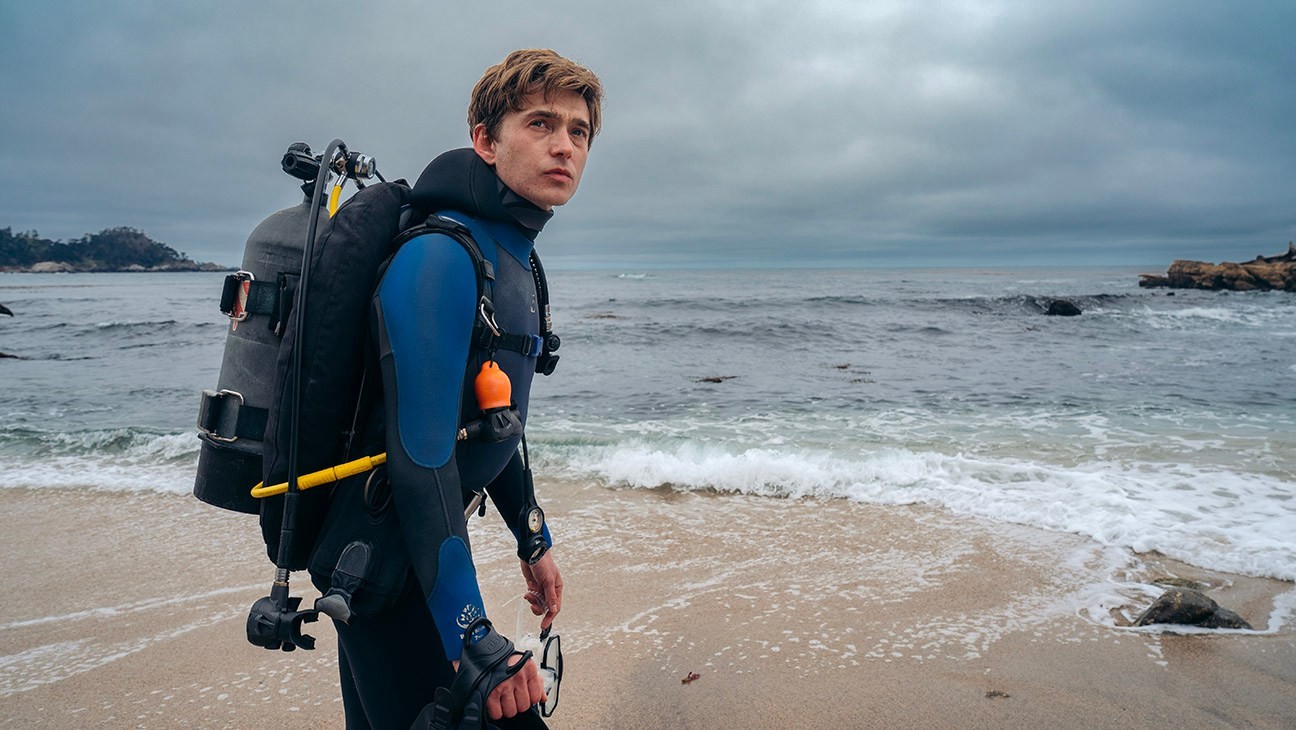
The survival thriller Whalefall ends with a family reunion at sea, but writer-director Brian Duffield and star Austin Abrams initially wanted no part of it. Duffield told The Hollywood Reporter in an interview published October 20, 2026, that 20th Century pushed for the epilogue after test screenings, and he came around once he saw what Abrams did with it.
The film, based on the 2023 novel by Iowa-born author Daniel Kraus, follows Jay Gardiner, an Iowa college student who returns to California's Central Coast a year after his estranged father, Mitt, played by Josh Brolin, died by suicide at sea. Jay dives near Montery Beach to find his father's remains, gets swallowed by a sperm whale, and survives with roughly an hour of oxygen and the skills his dad drilled into him every morning starting at 4:30. The Hollywood Reporter laid out the full spoiler-heavy conversation with Duffield, Abrams, and Brolin this week.
Why the ending changed after test screenings
Duffield originally ended the movie with Jay's rescue. He liked the abrupt finality of older films, the kind that cut away the moment the hero is pulled from the water. The studio disagreed, and test audiences wanted to see Jay's mother and sisters again after spending the whole movie watching him struggle to connect with them.
That scene at the end was something the studio really pushed for, and Austin and I were both a little like, I don't know, Duffield said. Isn't it cool to just end with him getting fished out, seeing that he's survived, and then be done with it?
The extra scene reunited the Gardiner family and family friend Hewey, played by John Ortiz, on the water. It also shows the cost of Jay's escape in full view: severe scarring on his neck and the loss of his left arm, which he sacrificed to trigger the explosion that killed the whale and set off the titular whalefall, the ecological phenomenon where a dead whale sinks to the ocean floor and feeds deep-sea life for centuries.
Additional photography took place earlier this year, right after Abrams finished work on Resident Evil with director Zach Cregger. Abrams showed up with a different haircut, which Duffield said worked in the film's favor by signaling that time had passed.
The letter everyone is talking about
One plot point never appeared in Kraus' novel: the letter Mitt left behind for Jay, which Jay refuses to open for most of the story. According to MSNBC TV News, Kraus always knew what the letter said, and Duffield agreed with his version before passing it along to Abrams, who played the unseen reveal with a tearful laugh.
Duffield confirmed the production actually shot a close-up of the letter, but the studio told him to leave it ambiguous. The studio was just like, no, it's better without it, Duffield recalled. And I was like, great, that suits me fine.
He offered one hint. The contents are textually embedded in the film, he said, and the note is short. Mitt is not going to write a long letter to someone that doesn't want to speak with him, but it says enough that Austin was really excited once he heard what Daniel and I think it said.
Abrams told the outlet he will never reveal the contents, arguing the audience's own interpretation carries more weight than any written words. You're also projecting whatever you wish a family member had said to you if they'd written you a letter before they died, Abrams said. So there's value in the not knowing.
Brolin took a different route. He never asked Duffield or Kraus what Mitt wrote. I created what Mitt wrote in my head, and I never wrote it down, Brolin said.
A father's toughness, and what it cost
Duffield told The Hollywood Reporter that Mitt's harsh treatment of Jay comes from love, not cruelty. Mitt, a lifelong waterman with scars the film never explains, learned he was dying of cancer and concluded his son was not ready for the world. His response was to push Jay harder.
During the film's boat fight, Mitt says plainly, I failed you, a line Duffield said Jay hears as an insult but Mitt means as a confession. The director compared Mitt to famous sports fathers like Earl Woods and Richard Williams, men who raised their children from birth for a single purpose.
There's a part of Mitt that deeply, deeply loves his son, but he really wants to be tough on him so that he doesn't have the same life experiences he's had, Duffield said. And weirdly, Mitt achieves that in the end.
Duffield added that had Mitt lived another decade, father and son probably would have found their way to a healthy relationship. Death doesn't care about your character development, he said. It comes when it wants.
What the whale really means
The title refers to the ecological event, but Duffield and Kraus see it as something more. Daniel ties it to our humanity and how losing loved ones can ripple through time, Duffield said.
Inside the whale, Jay speaks with what appears to be his father, and Duffield left the moment open to interpretation. He noted Jay is partially brain-damaged by that point, running on toxic air and almost no oxygen, yet the film also suggests something genuinely spiritual happens. The director said the movie allows whatever reading the viewer brings to it.
Per Wikipedia, the film adapts Kraus' 2023 novel with Kraus co-writing the screenplay alongside Duffield. The book's final words, Sleeper, arise, echo the wake-up command Mitt barked at Jay every morning and a similar line from the Book of Jonah, and fans are already debating whether the letter reuses the phrase.
What happens to Jay after the whale
Duffield did not sugarcoat the injuries. Jay leaves the whale with a severely broken leg, a missing arm, collapsed lungs, blown-out ears, cracked ribs, and some brain damage. He spent a long stretch in the hospital.
But emotionally, Duffield said, Jay is in a very different and healed place. When viewers see him on the boat at the end, the weight is gone. The director called the whole ordeal a really great therapy session for the character.
The epilogue also answers a small practical question. With only one hand, Jay cannot open his father's letter alone, so his oldest sister, played by Jane Levy, helps him. The moment of family closure the studio wanted became the scene that convinced Duffield the studio was right all along.
FAQ
Is the letter in Whalefall ever revealed?
No. The filmmakers shot a close-up of it but chose to keep it ambiguous. Duffield said the contents are hinted at within the film itself.
Did the Whalefall ending change after filming?
Yes. The final boat scene was a pickup shot after test screenings, filmed once Abrams wrapped Resident Evil earlier this year.
Does Jay survive in Whalefall?
He does, but at a steep cost: a lost arm, a broken leg, collapsed lungs, and lasting scars.