
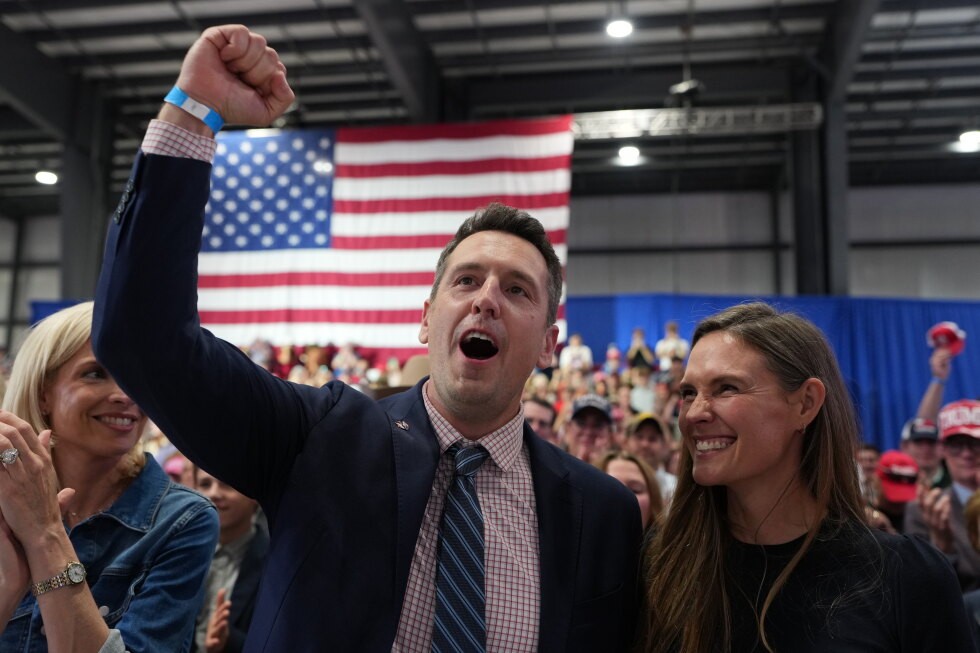
Iowa voters head to the polls Tuesday with control of Congress, an open Senate seat and the governor's office all on the ballot in one of the most consequential elections the state has seen in years.
The stakes are high for both parties. Republican Gov. Kim Reynolds and Republican Sen. Joni Ernst are both retiring, opening the state's top offices for the first time in more than a decade and giving Democrats their best shot in years at breaking a 16-year losing streak in races for governor and U.S. Senate. Republicans, meanwhile, are fighting to hold a Senate seat that could decide whether President Donald Trump's agenda advances through the final two years of his second term.
S Senate race: Hinson vs. Turek
The marquee race is the U.S. Senate contest between Republican Rep. Ashley Hinson and Democratic state Rep. Josh Turek, who are competing to succeed Ernst. Ernst's 2014 win helped Republicans secure a Senate majority under President Barack Obama, and according to AP NEWS, a Turek victory could hand Democrats the same leverage against Trump.
Hinson dominated the June 2 primary, taking 74% of the vote against former state Sen. Jim Carlin. Turek won about 63% against state Sen. Zach Wahls.
The money race tells a striking story. Turek raised roughly $18 million since July 1, compared with about $3.9 million for Hinson. But outside Republican groups have closed the gap, including $36 million in ad spending from a super PAC tied to Senate Majority Leader John Thune, according to the ad tracking firm AdImpact.
Governor: Lahn faces Sand
In the race for governor, Republican Zach Lahn, an entrepreneur and private school co-founder, faces Democrat Rob Sand, the state auditor and Iowa's only Democrat holding statewide elected office. Lahn pulled off a June primary upset over Rep. Randy Feenstra, who had Trump's endorsement. Sand ran unopposed for his party's nomination.
The winner will succeed Reynolds, whose retirement ends a long run of Republican control of the governor's office that began with Terry Branstad's 2010 return to the job.
Three competitive House seats
Hinson's Senate bid opened up the 2nd Congressional District, which she won in 2024 with 57% of the vote. The seat is now among the most competitive House races in the country.
Two Republican incumbents are also fighting to hold their seats. In the 1st District, Rep. Mariannette Miller-Meeks faces a rematch with former state Rep. Christina Bohannan, who came within 1 percentage point of unseating her in one of the closest House races of 2024. In the 3rd District, Rep. Zach Nunn is challenged by Democratic state Sen. Sarah Trone Garriott.
Trump carried both the 1st and 2nd Districts with roughly 54% of the vote in 2024 and took about 52% in the 3rd District. He campaigned for Hinson, Lahn and other Republicans at an Oct. 22 rally in Sioux City.
Where the battlegrounds are
Iowa was once a presidential swing state, but Trump carried it three times, most recently in 2024 by 13 points. It has been more than a decade since Iowans elected a Democratic governor or U.S. senator, and 24 years since they elected Democrats to both offices in the same year.
Democrats typically run strongest in the population centers of Des Moines, Cedar Rapids, Iowa City, Ames and Waterloo, while Republicans pile up wide margins in rural counties, including traditionally Republican Woodbury County in western Iowa, where Trump held his rally.
Two counties will be worth watching closely. Trump narrowly carried Dallas County, home to West Des Moines, all three times, never topping 51%. Sand carried Dallas County by about 7 points in his 2022 race for state auditor and narrowly lost Scott County, home to Davenport, where Clinton and Biden both edged Trump in 2016 and 2020.
When polls close and how votes are counted
Polls close at 8 p.m. Central time, and the ballot includes U.S. Senate, U.S. House, governor, secretary of state, state auditor, treasurer, agriculture secretary, attorney general, state Senate, state House and a statewide ballot measure.
About 1.2 million votes were cast in Iowa's 2022 Senate race, and roughly 30% of that vote was cast early in person or by mail. Voters still deciding can find early voting details through Iowa Public Radio's guide, which notes that county auditors' offices were open for in-person absentee voting through Nov. 3.
About nine in 10 counties are expected to release nearly all their absentee and mail results in their first vote updates Tuesday night, according to WHO13. The largest counties, including Polk, Scott and Black Hawk, are expected to report all vote types at the start of the night.
In 2024, the AP first reported results one minute after polls closed, reached the halfway mark by 10:33 p.m. Eastern, and counted about 99% of votes by 3:20 a.m.
What happens if a race is close
Iowa has no automatic recount law. Candidates for statewide and federal offices may request a recount if the winning margin is less than 0.15% of the total vote. For all other offices, the threshold is less than 1% of the vote or 50 votes, whichever is smaller.
The AP does not make projections and declares a winner only when no scenario remains in which a trailing candidate could close the gap.
Frequently asked questions about Iowa's 2026 election
When do Iowa polls close on Election Day?
Polls close at 8 p.m. Central time, which is 9 p.m. Eastern.
Who is running for Iowa governor in 2026?
Republican Zach Lahn faces Democrat Rob Sand in the race to succeed retiring Gov. Kim Reynolds.
Who is running for Iowa's open U.S. Senate seat?
Republican Rep. Ashley Hinson and Democratic state Rep. Josh Turek are competing to succeed retiring Sen. Joni Ernst.
How does a recount work in Iowa?
Iowa has no automatic recount. Candidates for statewide or federal office can request one if the margin is under 0.15% of the total vote.