
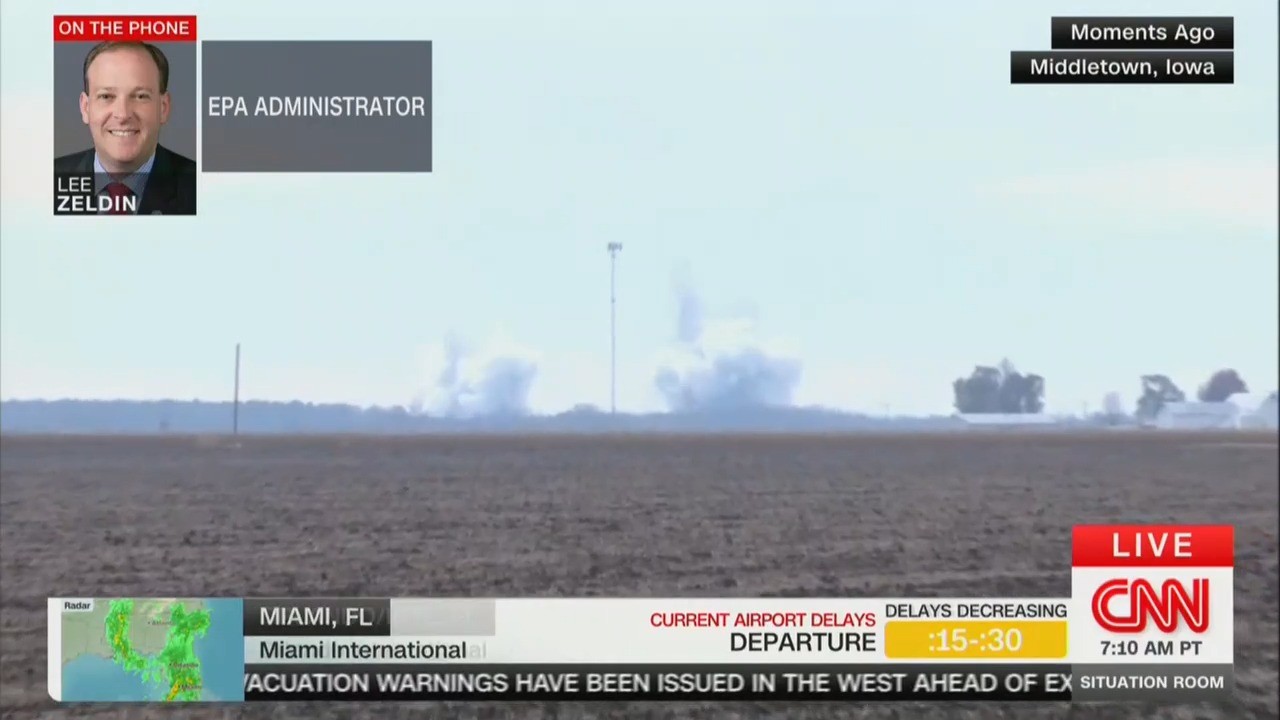
Environmental Protection Agency Administrator Lee Zeldin promised transparent safety testing Wednesday after the U.S. Army detonated five tons of deteriorating lead azide in Iowa.
Zeldin said the EPA would release verified information about air, land and water as quickly as possible rather than issue a premature declaration that surrounding communities were safe. President Donald Trump praised the controlled detonation on Truth Social Wednesday morning, saying it exceeded expectations.
Army destroys unstable lead azide stockpile
The Army carried out the controversial blast to destroy lead azide, a dangerous compound that officials said had been degrading and could have exploded on its own at any time. Zeldin described the operation as a “whole government effort” during an appearance on CNN’s The Situation Room with co-anchor Pamela Brown.
Trump addressed the operation on social media after the blast. TIME reported that Zeldin also said the detonation had “exceeded expectations.”
The immediate federal response now centers on testing, public communication and any cleanup that the results may require. Zeldin said initial reports showed little lead in surrounding areas, crediting Army measures intended to limit the spread of dangerous material.
The EPA offered an even more specific initial assessment of airborne lead. The Guardian reported that the agency said real-time air monitors were showing “ZERO detection of airborne lead throughout the region” and that the monitors had continued collecting data.
Those early readings did not prompt Zeldin to issue a blanket safety declaration. He said the government still needed to gather and publish information covering air, soil and water.
Zeldin invokes EPA failures after 9/11
Zeldin, a former Long Island congressman, said his experience as a New Yorker during the Sept. 11, 2001, terrorist attacks shapes his approach to the Iowa detonation.
“I’m not going to rush and just immediately declare, everything is, you know, safe before I can receive the data that we can transparently release it publicly,” Zeldin said.
He pointed to the assurances former EPA Administrator Christine Todd Whitman gave days after terrorists flew two airplanes into the World Trade Center. Whitman told the public that Lower Manhattan’s air and water were safe as first responders searched the ruins and crews cleared the site.
That assurance became a lasting controversy as responders suffered illnesses and deaths following exposure to the toxic plume. Zeldin said the EPA should not have made its immediate declaration about the air.
“We’ve lost a lot of, you know, our 9/11 first responders, due to their exposure to that toxic plume down at the Trade Center site,” he said.
His comments place government accountability at the center of the EPA’s response in Iowa. The administrator said his instruction to agency personnel is to provide accurate information quickly and openly, according to Mediaite’s report.
What testing and monitoring happens next?
Zeldin said the EPA was deploying personnel to conduct soil and water sampling and would undertake any necessary remediation in the hours following the detonation. The work adds to the air monitoring already in place.
The agency has also accelerated its laboratory process. Zeldin said obtaining results would not take days and that the EPA would post information on a website as soon as it became available.
“We only want to communicate accurate information,” he said.
That commitment means residents should expect additional updates as samples are analyzed. Zeldin said the EPA was prepared to use comprehensive measures to reduce risks to communities and families while limiting disruptions.
The distinction between preliminary readings and a final assessment is central to his message. Early air-monitor results can provide immediate information, but soil and water testing address separate questions about where material settled and whether cleanup is needed.
Safety guidance for Iowa residents
Federal officials continued urging residents to follow public safety advisories while the initial assessment proceeds. Zeldin said people should remain indoors with windows and doors closed while dust passes.
Residents were also advised to use a wet cloth to wipe outdoor surfaces that children touch. The EPA specifically identified play sets, railings and window sills.
The guidance gives families practical steps to reduce contact with settled dust while officials wait for more complete results. Zeldin said residents should continue watching for additional feedback from public safety authorities.
The Army’s decision to proceed reflected its warning that the aging compound presented its own danger if left in place. With the detonation complete, the EPA’s published sampling results will determine the next phase of the federal response.
Iowa lead azide detonation questions
Why did the Army detonate lead azide in Iowa?
The Army said the five-ton stockpile was degrading and could explode on its own at any time. Officials conducted a controlled detonation to destroy the unstable compound.
Did monitors detect airborne lead after the blast?
The EPA said its real-time monitors initially reported zero detection of airborne lead throughout the region and never stopped collecting data. Zeldin nevertheless declined to declare all conditions safe before reviewing broader test results.
When will the EPA release more information?
Zeldin said the EPA had expedited laboratory work so the process would not take days. The agency plans to publish verified information on its website as it becomes available.
What should residents do with outdoor dust?
The EPA advises residents to follow public safety notices, stay indoors with windows and doors closed while dust passes, and wipe play sets, railings and window sills with a wet cloth.