
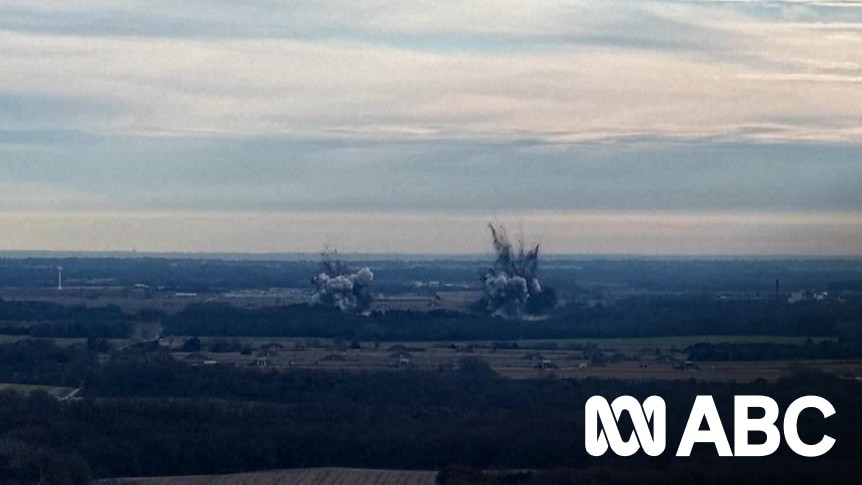
The U.S. Army destroyed nearly five tons of unstable lead azide at the Iowa Army Ammunition Plant near Middletown on Wednesday, Nov. 25, and federal officials said air tests detected no lead several hours after the controlled blasts.
The operation came on the eve of Thanksgiving after days of uncertainty for nearby families, farmers and livestock owners. The Army reported no secondary explosions or infrastructure damage, while the Federal Emergency Management Agency later issued an all clear, according to Yahoo's detonation coverage.
Why the Army acted before winter
Lead azide is a sensitive explosive, and Army officials concluded that leaving the stockpile in place carried its own dangers. According to reporting by John Lyons, Americas editor for the Australian Broadcasting Corporation, officials warned that touching or moving the chemicals could set off an explosion.
Falling temperatures presented another risk. With winter approaching, the Army decided that waiting could allow the stockpile to become an uncontrolled emergency rather than a planned operation.
Crews also needed calm weather. The Army waited for conditions with no wind to reduce the chance that toxic dust would travel away from the munitions facility.
That requirement left residents without a firm detonation date. People who had spent days preparing received only a few hours' notice once conditions allowed the operation to proceed.
Evacuations and concerns on nearby farms
People within eight kilometers, or about five miles, of the facility were encouraged to leave. The Army warned that dust could travel much farther under the wrong conditions, with Lyons reporting a potential reach of roughly 40 to 50 kilometers, or 25 to 31 miles.
Some residents outside the inner evacuation area were advised to go indoors and bring livestock inside when possible. The instruction reflected concerns that animals as well as people could breathe contaminated dust.
Rob Cekada, director of the Bureau of Alcohol, Tobacco, Firearms and Explosives, told reporters in Middletown that about 21 people voluntarily evacuated their homes before the detonation, Yahoo reported.
The timing added to the disruption. Families were making Thanksgiving plans while trying to decide whether to leave, where to go and how to protect animals and property.
International Business Times reported that residents' concerns centered on lead dust, public health, livestock and possible environmental contamination. Those questions did not disappear when the explosions ended.
What tests found after the detonation
The Army said the controlled detonations did not trigger secondary explosions. Officials had worried that one blast could set off additional explosions that crews had not anticipated.
The Army also said no infrastructure was damaged. The Environmental Protection Agency monitored the air and reported no lead detected in readings taken several hours after the operation.
That result addressed the most immediate fear, an airborne lead hazard in the hours following the blasts. It did not amount to a final report on soil, water or property around the plant.
EPA officials planned to continue collecting air, land and water samples in the following days. Those results will matter to residents deciding whether the federal response was thorough and whether further cleanup or testing is needed.
EPA Administrator Lee Zeldin also provided a phone number for local residents with questions or concerns during a live CNN appearance, according to Yahoo. State and federal agencies should keep those lines of communication open as additional samples are analyzed.
What Middletown residents should watch next
The next test of the operation is the monitoring record, not the size of the blast or the speed of the all clear. Residents need timely access to sampling locations, laboratory results and any steps officials recommend for homes, wells, fields and livestock.
FEMA's all clear marked the end of the immediate emergency. Continued EPA testing will determine whether the initial clean air readings are matched by results from the ground and water.
For now, the available official findings are narrow but encouraging: no secondary explosions, no reported infrastructure damage and no lead detected in the air several hours after the detonations.
Iowa lead detonation questions
Why did the Army detonate lead azide in Iowa?
The Army said the stockpile was too unstable to move safely. Officials also warned that falling winter temperatures could trigger an explosion, prompting the controlled operation before Thanksgiving.
Was lead found in the air after the blasts?
The EPA said its air readings detected no lead several hours after the controlled detonations. Monitoring of air, land and water was scheduled to continue.
How many people evacuated near Middletown?
ATF Director Rob Cekada said about 21 people voluntarily left their homes near the Iowa Army Ammunition Plant before Wednesday's detonation.