
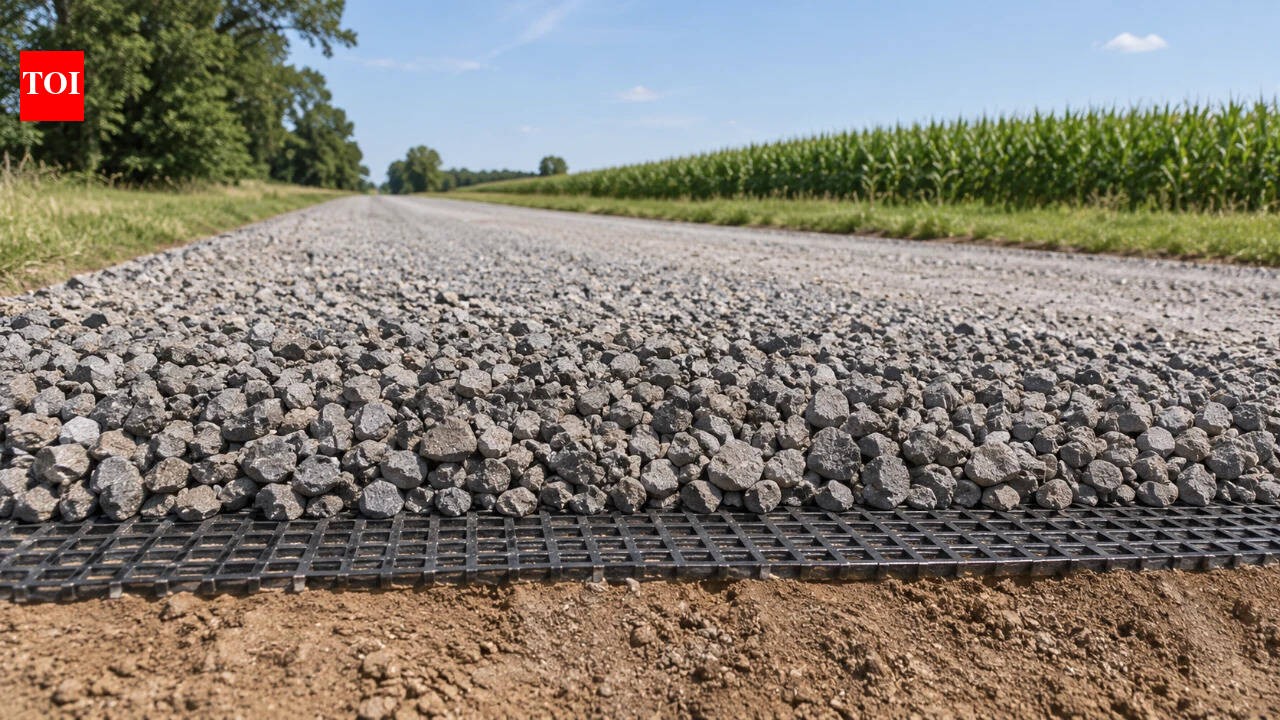
Iowa State University engineers have found that a road reinforcement layer made from recycled plastic can raise the bearing capacity of gravel roads by up to 30%, according to full-scale trials completed in Buchanan County. The results, published in January 2026 in the journal Transportation Geotechnics, point to a practical way to stretch county road budgets while putting waste plastic to work.
The trials also showed a 25% increase in road stiffness and a 10% to 20% reduction in moisture within the road base and subgrade, the layer of soil beneath the gravel. Less moisture means less softening during Iowa's wet springs and freeze-thaw cycles, which are among the biggest drivers of gravel road deterioration.
Why Iowa's Gravel Roads Need Help
Iowa has more than 71,000 miles of gravel county roads, according to Iowa State University's report on the project. Even though those roads carry relatively light daily traffic, they routinely absorb heavy loads from grain trucks, farm equipment, construction vehicles and service trucks. For rural communities, keeping those roads passable is a year-round challenge for county engineers working with limited budgets.
Weather does much of the damage. Rain, snowmelt and repeated freeze-thaw cycles weaken the base beneath the gravel surface, forcing counties to regrade, re-rock and rebuild the same stretches over and over. The research team set out to test whether a buried reinforcement layer could slow that cycle down.
How Engineers Built a Road Layer From Recycled Plastic
The work was carried out by researchers with the Program for Sustainable Pavement Engineering and Research, known as PROSPER, at Iowa State University. Their design combines two materials into a single composite: a geogrid, which is a plastic grid used to reinforce roads and other structures, bonded to a nonwoven geotextile fabric.
According to the College of Engineering at Iowa State, the team 3D printed the geogrid using a filament made entirely from recycled plastic. The project received partial funding from the Iowa Department of Transportation and the Iowa Highway Research Board, and it forms part of a broader research effort into alternative recycled materials for road construction. Another material under study is discarded wind turbine blades, which have become a disposal headache as older turbines come down across the Midwest.
What the Buchanan County Field Trials Showed
Researchers built three full-scale test sections on gravel roads in Buchanan County to compare reinforcement methods under real conditions. One section used the recycled plastic composite geosynthetic, a second used a nearly identical geosynthetic made from virgin plastic, and a third served as the control section with no reinforcement.
The test sections were subjected to truckloads, agricultural operations and a full range of seasons. Engineers measured performance using Light Weight Deflectometer testing, California Bearing Ratio testing, rut depth measurements, sand cone density testing, and moisture and temperature sensors buried in the road structure.
The results, first reported by