
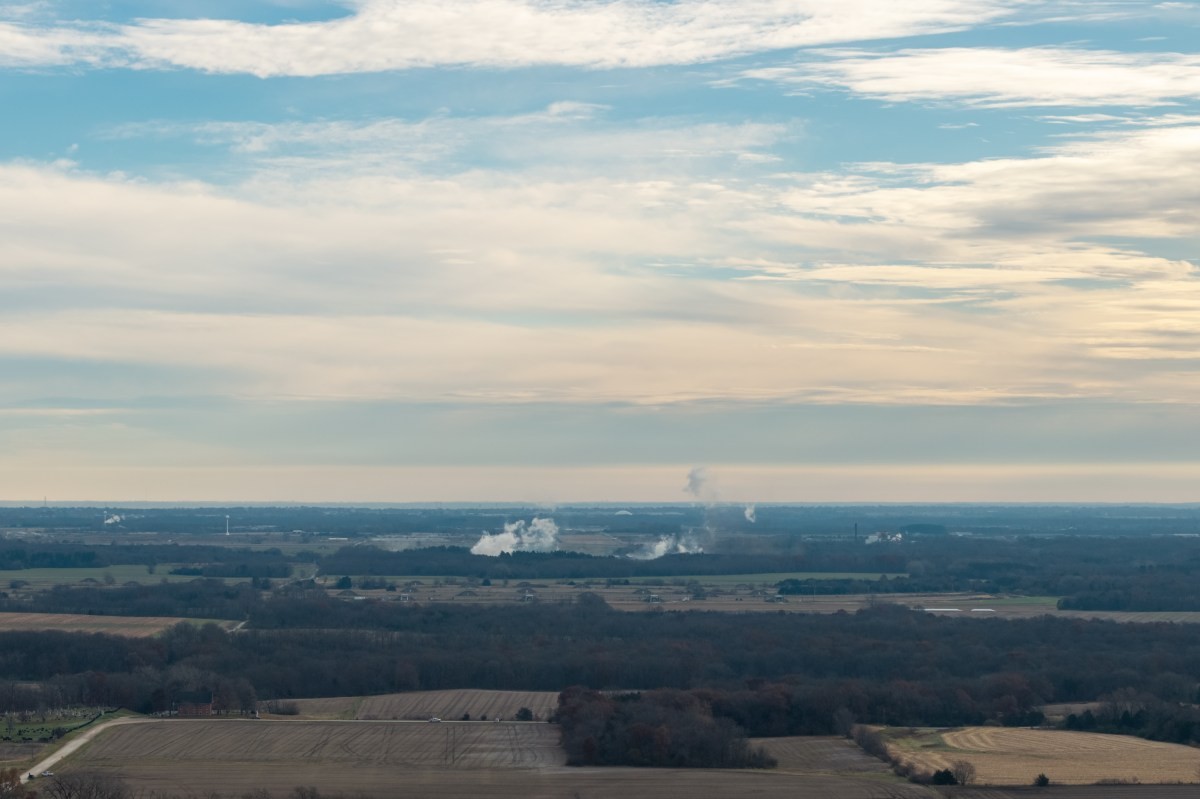
The U.S. Army destroyed roughly five tons of unstable lead azide at the Iowa Army Ammunition Plant on Wednesday, and federal officials reported no detected lead in initial air tests.
The controlled detonation took place at about 9 a.m. Central time at the Middletown facility. Army officials said all 68 drums were destroyed without secondary explosions or damage to surrounding infrastructure, removing the danger of a spontaneous explosion.
Trump administration credits coordinated federal response
President Donald Trump said early reports showed the Army's mitigation efforts had “far exceeded expectations.” Administration officials also praised White House Chief of Staff Stephen Miller for coordinating work among the Army, Environmental Protection Agency, Federal Emergency Management Agency and other federal offices.
According to Newsweek's report on the operation, EPA Administrator Lee Zeldin highlighted Miller's role during a CNN appearance after the blast.
“I've never witnessed an individual take reins of an interagency process as exceptionally as I have over the last few days,” Zeldin said.
Zeldin said initial air monitors showed “zero detection” of lead. He stressed that crews would keep collecting samples rather than treating the first readings as the final word.
White House communications director Steven Cheung credited Miller with convening what he called a historic, whole-of-government response. Katie Miller, Stephen Miller's wife, said federal experts worked around the clock to prepare for the controlled explosion.
ATF Director Rob Cekada said Trump and Miller made federal personnel, technology and equipment available for the operation.
“President Trump, and Chief of Staff Miller, ensured that we had every available tool and every available asset in the federal government,” Cekada said.
Yahoo reported that administration officials promoted the operation's initial results through cable news appearances and social media posts Wednesday.
Why the Army detonated the material
Lead azide is a highly sensitive primary explosive used in munitions. The Army said the material in the 68 drums, totaling more than 9,700 pounds in net explosive weight, had severely degraded and crystallized.
That condition left it vulnerable to friction, vibration, heat or shock. After a multiagency technical review, officials decided that moving the drums, chemically neutralizing their contents or transporting the material would create an unacceptable risk.
They selected an in-place detonation as the only workable way to remove the explosive hazard. The decision followed days of public concern and a federal court challenge from environmental groups opposed to the EPA's emergency permit.
The U.S. Court of Appeals for the Eighth Circuit allowed the operation to proceed.
Blast design limited lead dispersal, officials say
U.S. Army Maj. Gen. Eric Shirley said the results exceeded expectations and credited the explosive ordnance disposal personnel and soldiers at the site.
“All of the lead azide barrels were definitively removed,” Shirley said. “There was no secondary explosions, there was no kickout. There was no infrastructure damage in or around our installation.”
Crews used more than 3,600 gallons of aqueous foam to reduce the possible spread of lead. Cekada said the explosion was designed to drive its force into the ground and through a planned blast channel.
“One hundred percent as planned,” Cekada said of the mitigation design.
The Guardian reported that the Army called the operation a “huge success” and said the threat of spontaneous explosions had been eliminated.
Lead testing will continue around Middletown
The successful removal of the explosive stockpile does not end questions about lead contamination. Detonation breaks down lead azide, but the lead itself remains and can be carried in fumes or particles.
The Centers for Disease Control and Prevention says no safe blood lead level has been identified in children. Even low exposure levels have been associated with developmental delays, learning difficulties and behavioral problems. Pregnant women and developing fetuses also face heightened risks.
High exposure in adults can cause anemia, kidney damage, neurological problems and reproductive effects. Because exposed children may not appear sick, a blood lead test is the primary way to determine exposure.
Before the blast, the EPA deployed 300 agency personnel and contractors. They collected 1,216 baseline samples: 650 soil samples, 297 dust samples, 210 water samples and 59 air samples.
Air-monitoring equipment supplied data at five-minute intervals during the operation. Post-detonation testing will cover air, soil, dust and water, and the EPA said remediation would follow if testing finds contamination.
What happens next for nearby residents
Residents inside a five-mile evacuation zone extending southwest of the plant were urged to leave before the detonation. People outside that zone were encouraged to shelter in place and follow official updates.
Federal officials said evacuated residents would be notified when authorities issue an all-clear and allow them to return home. Cekada promised additional testing and public updates in the coming days and weeks.
“We will have additional resources and testing that will go on in the coming days to weeks just to ensure that we communicate clearly and openly,” he said.
The immediate explosive threat is gone, according to the Army. The next measure of the operation will come from comprehensive sampling results and whether they confirm the initial air readings around Middletown.